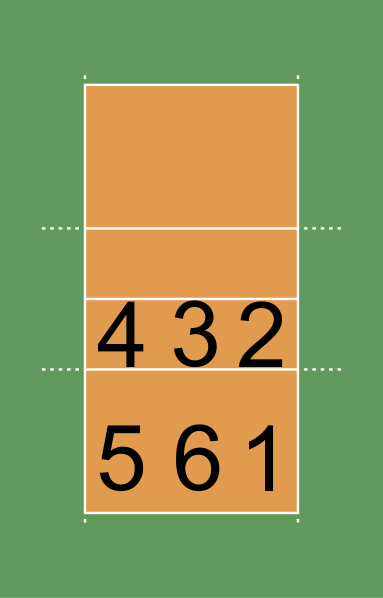
Dzisiaj postanowiłem wyjaśnić, czym są ustawienia na boisku. Ustawienie, zwane również rotacją jest porządkiem zawodników na boisku. Istnieje 6 różnych ustawień. Są one bezpośrednio powiązane ze strefami boiska. W kolejności ustawienia to 1, 6, 5, 4, 3, 2. Poniżej zamieszczam boisko z opisanymi strefami, na które się dzieli:
So, what is a rotation and how do you recognize it? Rotation 1, commonly known as P1 (from the Italian word for setter, Palleggiatore), occurs when the setter is in zone 1 at the moment of the service. The next rotation is P6, where the setter starts in zone 6, and so on. A rotation change occurs when the receiving team wins a point. As players rotate, they shift zones in a clockwise direction.
Even before the service is executed, the serving team should position themselves in their target locations—meaning the middle blocker in the center of the net, the outside hitter in zone four, and, for example, the opposite in zone two (if they are in the front row). The server must be behind the endline. As for the receiving team, they must stand according to their rotation, and only when the server tosses the ball for service can they switch positions. The players on the court are positioned in 2 lines: the front row (zones 2, 3, and 4) and the back row (zones 1, 6, and 5). You can check if a rotation is correct by following two rules:
- each back-row player of the receiving team must stand further from the net than the corresponding front-row player in front of them,
- each player of the receiving team must be in their proper position according to the starting lineup.
Going into detail, there is no set distance required between players, but the front-row player must have at least part of their foot closer to the net than the back-row player behind them. A similar rule applies to players in the same row—for example, in positions 5 and 6. The player in zone 6 must be further from the sideline than the player in zone 5.
There are two phases of starting positions in each rotation: the service phase (break point) and the reception phase (side-out). The starting position differs because the priorities change in each scenario. When we serve, the priority is block-defense; when we receive, our focus is on serve reception and executing the attack.
ROTATION ONE – S1
Service phase (Break point)
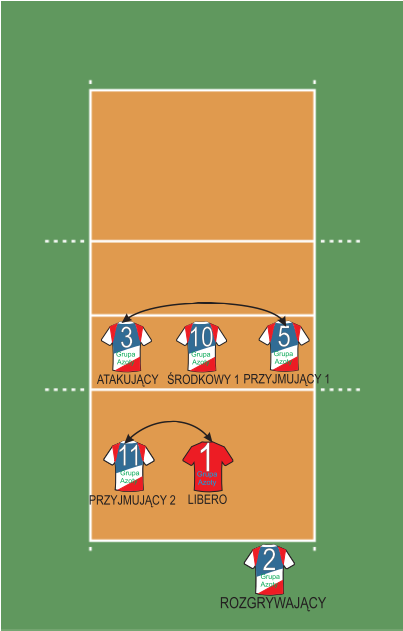
In rotation one (P1), the Setter serves (in our case, number 2). Even before the service is executed, the Opposite switches positions at the net with Outside Hitter 1. This is done so that the players can play in their nominal positions during a potential counter-attack. At the same time, Outside Hitter 2 switches with the Libero, allowing the former to attack from the back row (the pipe) during the counter-attack. After serving, the Setter runs into zone 1. Below is a match video illustrating this rotation:
Reception phase (Side-out)
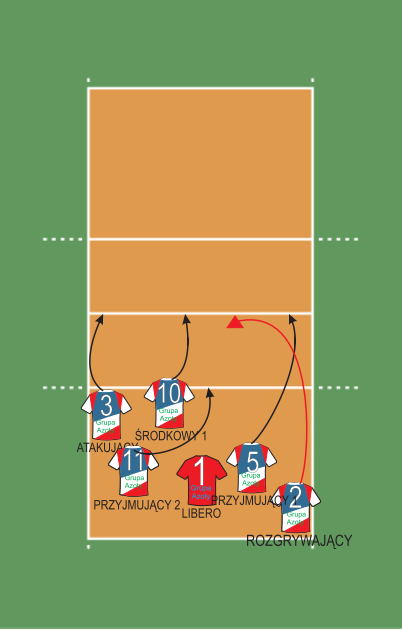
The players in the front row are the Opposite (no. 3), the Middle Blocker (no. 10), and Outside Hitter 1 (no. 5). In the back row, we have the Setter (no. 2), Outside Hitter 2 (no. 11), and the Libero (no. 1) subbed in for Middle Blocker 2 (who left the court after his service turn—more on that later). In the reception phase, at the moment of the opponent’s service toss, the Setter penetrates to the net (the red line shows the setter’s movement, and the triangle is the target destination). The Opposite is already set to attack from the left or right wing (depending on the team’s strategy), while Outside Hitter 1 is ready to receive the serve and then attack from the wing opposite to the opponent’s block. After receiving the serve, Outside Hitter 2 is ready to attack from the back row.
If you have any questions regarding this post, feel free to ask—I’ll be glad to answer them.
There are still five more rotations to cover!
Would you like to learn more?
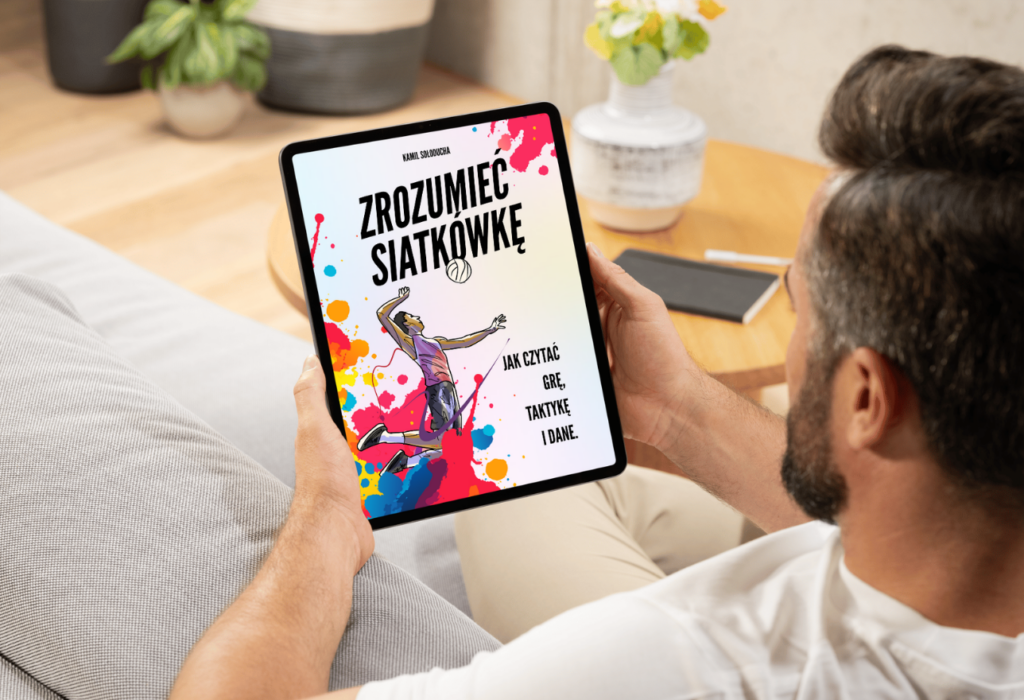
I invite you to check out my e-book ‘Decoding Volleyball’. From it, you will learn
-> More details on rotations and rotation combinations.
-> How the rules of volleyball have evolved over the years.
-> What positions players are assigned to on the court.
-> What goals players have in each specific position.
-> What zones, subzones, the attack line, and the defense line are.
-> What the starting lineup represents.
Grab your copy of the e-book!